The Genesis Parent Access Module includes a facility to send email messages to parents and students. The emails are sent to the address of the account login, which is typically always an email address.
Emails can be sent for a variety of reasons, including:
- Initially creating a Parent Logon Id, ex: a 'welcome' letter to the Portal
- Requesting a Password Reset from a Parent or student's account
- General information emails
- Automatic notifications by Email to parents and students when they receive alerts
Related Articles
How to mass email parents/students using the portal
Configuring automatic parent alerts
CONTENTS
- List of District Email Templates
- Creating an Email Template
- Modifying an Email Template
- Macro Reference Guide
- How to Attach a Document to an Email Template
- How to Attach a Hyperlink to an Email Template
- Text Messsage Templates
List of District Email Templates
Email Templates are located on the Parent Access>Setup>Email Templates screen.
The screen lists all possible templates that can be sent to Parent and/or Student portal accounts. Displays the subject of the attached email message, whether the template is to be used for password notifications for parents/guardians, password notifications for students, whether it has attachments.

The Parents>Setup>Email Templates screen with the list of templates is shown above.
Creating an Email Template
- To create an Email Template, go to the screen above and click the Add New Email Template button to open the pop-up and fill the details:
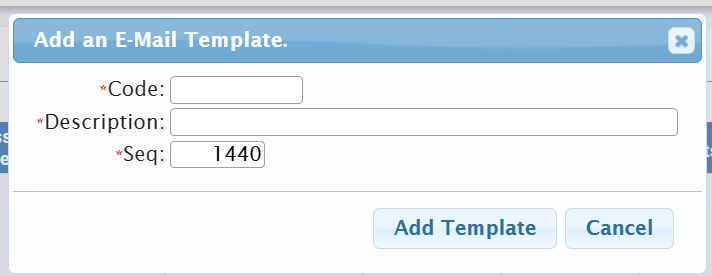
- To create the template, fill in the Code and the Description fields. The Seq field is simply a sequence number that places this new template at the bottom of the list of templates. You can adjust the numeric Sequence # to change the new template's location in the list.
- Then click Add Template to add this new template to the list
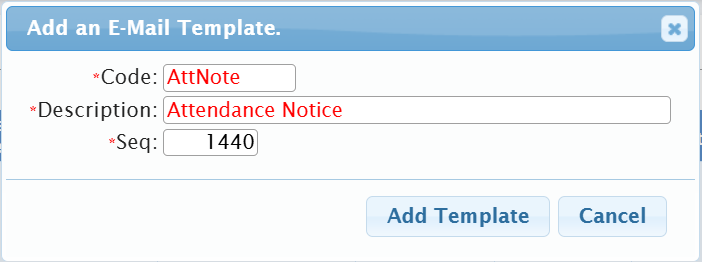
- This will then bring you to the Modify screen where the details can be filled out:
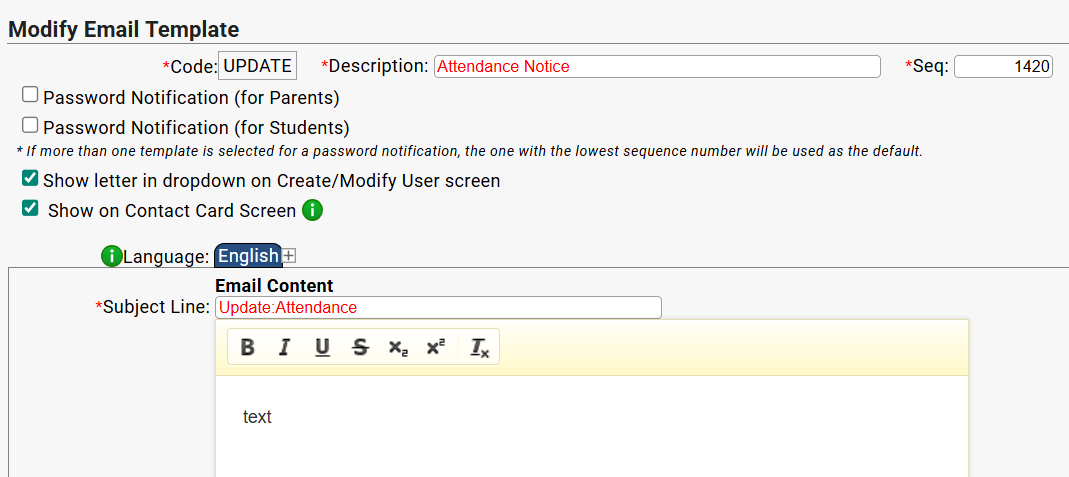
Each Template has five required fields:
- Code – a unique code that will identify this template internally
- Description – A description of the template that will make sense to administrative users (that is, those users who will have to send emails to parents).
- Sequence # - This number controls the position of this template in the list of templates.
- Subject Line – The Subject Line for the email that will be sent
- Body Text – The text of the email message to be sent.
There are four additional checkbox fields:
- Password Notification for Parents – Check this checkbox if this is the message to send when a Parent Logon's password is changed. Only one email template can be designated as the "Password Notification for Parents" template.
- Password Notification for Students – Check this checkbox if this is the message to send when a Student Logon's password is changed. Only one email template can be designated as the "Password Notification for Students" template.
- Show letter in dropdown on Create/Modify User screen – This checkbox adds this letter to this list of letters that can be sent directly from the Create/Modify User screen in the parents module.
- Attach Documents – Check this button to attach documents to the template that will be sent when the email is sent.
Steps to Creating an Email Template
- Click the "Add New Email Template" button.
- Enter a unique Code for this template.
- Enter a Description of the template
- Optionally update the defaulted Sequence number to position this template in the list of templates.
- Click the Add Template button to bring up the "Modify Template" screen.
- Enter a Subject for the email that will be sent. Subject lines can contain "email macros" that will be expanded when the template is used to send emails. See below "Email Macros".
- Enter the text of the Body of the Email. The Body of the Email can also contain "email macros" that will be expanded when the template is used to send emails. See below "Email Macros".
- If this email is to be the default "new password" Email template for Parents (users of the "Parent Resources" web access), check the "Password Notification (for Parents)" checkbox.
- If this email is to be the default "new password" Email template for Students (users of the "Student Resources" web access), check the "Password Notification (for Students)" checkbox.
- If this email is to have documents attached to it, check the "Attach Documents" checkbox.
- Click SAVE to save your updates. You can now attach documents (i.e. files) to this template.
Modifying an Email Template
To modify a template, select that template from the list of templates on the Parent Access>Setup>Email Templates screen and click the corresponding edit button to the right. You can then modify any of the fields and you can optionally remove and attach documents to the Template.
Example
The text of the standard "welcome" email message appears below. This is typically sent to parents when they sign up for Parent Access.
Welcome to the <DISTRICT_NAME> Parent Access Module. Please use the
 following information to login to the system:
 User Name: <PARENT_LOGON_ID>
 Password: <PARENT_PASSWORD>
 The Parent Access Module, provided by Genesis Educational Services, is a safe,
 secure way of enabling parents to access their own student's records using the
 internet.
 If you have any questions or concerns, please email <PARENT_ADMIN_EMAIL>.
Macro Reference Guide
Place macros in the following format: <MACRO_NAME>
Account Information Fields
Note: The following macros can be used generate information for BOTH Parent and Student account types
Macro | Sample Output | Notes |
PARENT_FIRST_NAME | John | |
PARENT_LAST_NAME | Smith | |
PARENT_LOGON_ID | parent@genesisedu.com | |
PARENT_PASSWORD | password | If you are using hashed passwords in Genesis, This will generate a NEW password when used. |
PARENT_EXPIRES | account expiration |
District Fields
Macro | Sample Output | Notes |
DISTRICT_NAME | Genesis Board of Education | |
PARENT_ADMIN_EMAIL | parentadmin@genesisedu.com | This is the email address of the Parent Access Administrator. This is also the email address that any email from Parent Access to the parents comes from. |
Student Information Fields
Note: Do NOT use these macros for notification templates. They generate for ALL students on a parent's account and not just the student who received the alert
Macro | Sample Output | Notes |
STUDENT_GRADE_SCHOOL_VERTICAL | Doe, John, Grade 11 in Genesis High School Doe, Jane, Grade 8 in Genesis Middle School | |
STUDENT_NAMES_VERTICAL | John Doe | You can :LUNCH_PIN to the end of the macro which will cause the lunch pin to appear next to the student. An example is <STUDENT_NAMES_VERTICAL:LUNCH_PIN> will produce this output: John Doe, Lunch Pin 1234. |
STUDENT_NAMES_HORIZONTAL | John Doe, Jane Doe |
Notification Fields
Note: Certain macros below only apply to emails sent for specific alert types. For example: the ATTENDANCE_DATE macro will only function when used in an Attendance notification email template.
Macro | Sample Output | Notes |
<TODAYS_DATE> | ||
<GB_AUDIT_DETAIL> | English: The grade of 85% was posted to Chapter 23 Test Mathematics: The grade of 95% was posted to Addition Homework | This was updated to display the assignment percentage rather than the overall grade for the assignment. For an assignment worth 10 points, instead of 'The grade of 8.0 was posted for My Homework', the text will read 'The grade of 80% was posted for My Homework'. (For Gradebook Grade Notifications) |
<GB_AUDIT_COURSES> | English, Mathematics | This will post the courses that are involved in this notification. (For Gradebook Grade Notifications) |
<STUDENT_NAME> | Smith, John | (For All Notifications) |
<STUDENT_FIRST_NAME> | John | (For All Notifications) |
<STUDENT_LAST_NAME> | Smith | (For All Notifications) |
<STUDENT_SCHOOL> | Genesis High | (For All Notifications) |
<STUDENT_GRADE> | 10 | (For All Notifications) |
<STUDENT_LOCKER> | 320 | (For All Notifications) |
<STUDENT_LOCKER_COMBO> | 18-25-12 | (For All Notifications) |
<ATTENDANCE_DATE> | 02/17/2019 | This will display date for the posted attendance that generated the notification (For Attendance Notifications) |
<OLD_ATTENDANCE_CODE> | 1 | This will display the attendance code prior to the posted attendance that generated the notification (For Attendance Notifications) |
<OLD_ATTENDANCE_DESCRIPTION> | Absent Unexcused | This will display the attendance code description prior to the posted attendance that generated the notification (For Attendance Notifications) |
<NEW_ATTENDANCE_CODE> | T | This will display the attendance code for the posted attendance that generated the notification (For Attendance Notifications) |
<NEW_ATTENDANCE_DESCRIPTION> | Tardy Unexcused | This will display the attendance code description for the posted attendance that generated the notification (For Attendance Notifications) |
<UPDATED_GRADE_LINK:parents.base.url> | Click to view (This text is a link to the Parents Gradebook page.) This link will default the Gradebook screen to only show updated grades. | The base URL for the Parent Portal goes after the colon in the macro. (follow the one that best matches your Genesis URL) Warning: This should be the last thing in the Email template or the macro won't work. (For Gradebook Grade Notifications - email only, will not work for text messages) |
<ATTENDANCE_LETTER_NAME> | Absence 5 Days | This will display the Attendance Letter's Name for the posted attendance that generated the notification (For Attendance Notifications) |
For Each Student Fields
Note: These macros are displayed in a block for each student attached to the parent user account. They will only work within a <START_FOR_EACH_STUDENT> ... <END_FOR_EACH_STUDENT> block. See the example below this chart for more details.
Macro | Sample Output | Notes |
E_STUDENT_ID | 8675309 | Student ID |
E_STUDENT_FIRST_NAME | Chris | First name of student |
E_STUDENT_LAST_NAME | Zinn | Last name of student |
E_STUDENT_FULL_NAME | Zinn, Chris | Last name, First name of student |
E_STUDENT_FULL_NAME2 | Chris Zinn | First name Last name of student |
E_STUDENT_CURRENT_SCHOOL_ENTRY_DATE | Student's Current Year School Entry Date | |
E_STUDENT_CURRENT_SCHOOL_URL | Student's Current School's URL | |
E_STUDENT_CURRENT_SCHOOL_ADDRESS | Student's Current School's Address | |
E_STUDENT_CURRENT_SCHOOL_PRINCIPAL | Student's Current School's Principal | |
E_STUDENT_USER_TEXT_code | test | This will look up a corresponding UserText field and display its value. The codes for the text fields can be found on the Setup.Districts.User Text screen. |
E_STUDENT_USER_FLAG_code | yes | This will look up a corresponding UserText field and display either yes or no. The codes for the text fields can be found on the Setup.Districts.User Flag screen. |
<E_STUDENT_NEXT_SCHOOL> | ||
<E_STUDENT_NEXT_GRADE> | ||
<E_STUDENT_NEXT_HOMEROOM> | ||
<E_STUDENT_NEXT_HR_TEACHER> | ||
<TODAYS_DATE> |
Example
The following is information for each of the students on your parent account:
<START_FOR_EACH_STUDENT>
First Name: <E_STUDENT_FIRST_NAME>
Last Name: <E_STUDENT_LAST_NAME>
Logon Id For Network: <E_STUDENT_USER_TEXT_NETWORKLOGINID>
<END_FOR_EACH_STUDENT>
Expression Fields
The templates also have an expression builder box below the text area. Expressions may also be inserted into the Body Text to add other fields that don't already exist as a template macro. Note: These fields must also be inserted in between the START and END for each student macros, as in the above example.
For example, the following expression can be used to inform the parent of the homeroom teacher's name for all of their students: ${student.homeroomTeacher}
To search for an expression field, click the brown box icon to the right of the Expression box:
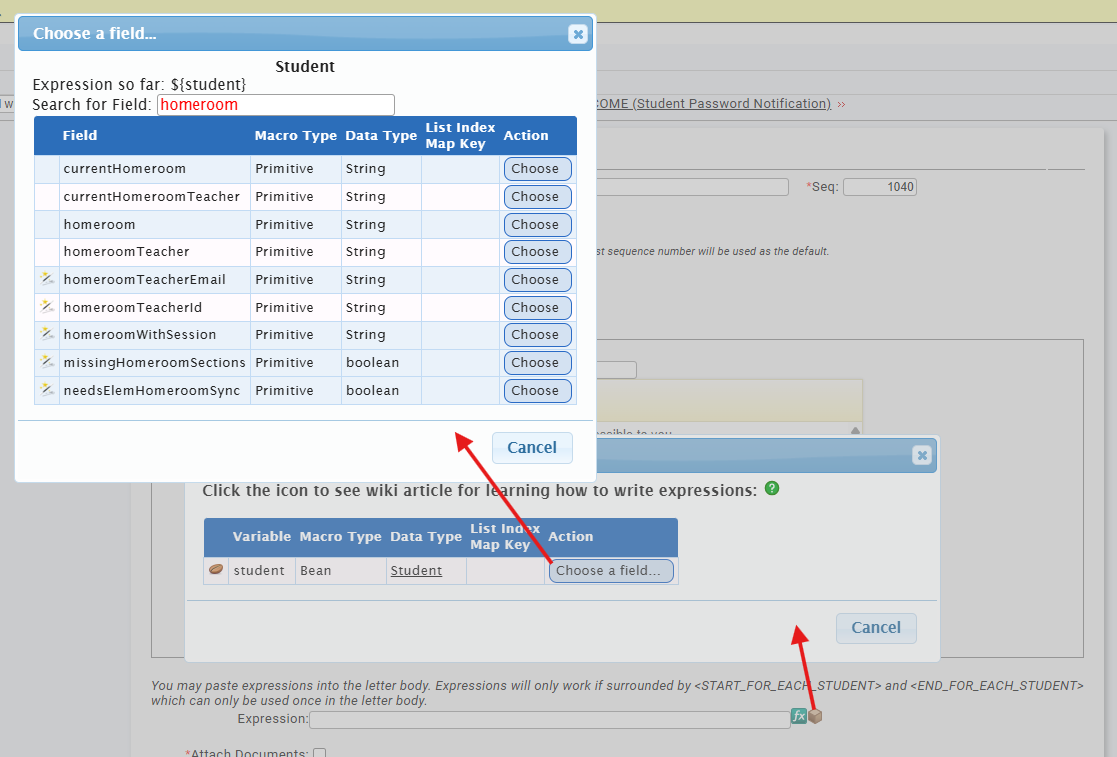
Click Choose a field and the following pop up will allow searching for possible fields based on keyword.
Click Choose next to the field in order to display that field as an expression in the Expression box below.
Copy the selected expression and then Paste into the Body Text where it should be displayed.
How to Attach a Document to an Email Template
You can modify/attach documents to email templates via Parent Access>Setup>Email Template>Modify Template.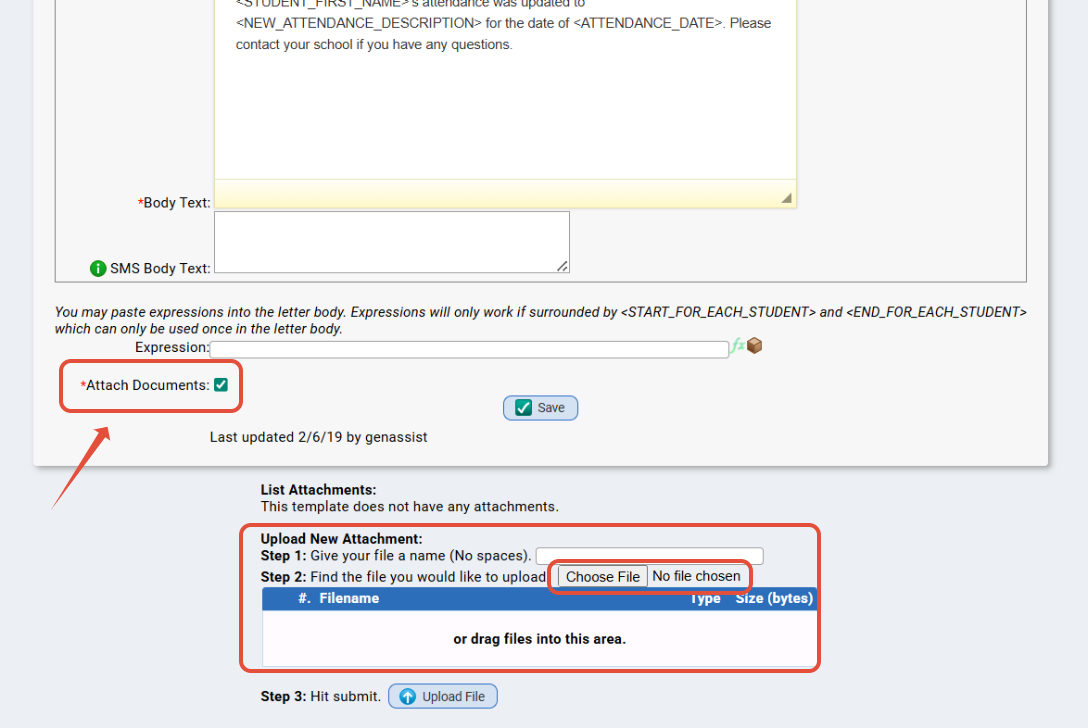
To attach a file do the following:
- Check off "Attach Documents" and save.
- Provide a name for the file. This is the name that will appear in the email message.
- Click the "Choose File" button to bring up a standard File Dialog. Locate the file to be attached to the template.
- Click the "Upload File" button to upload the file to Genesis and attach it to the template.
- Click "SAVE"
How to Attach a Hyperlink to an Email Template
Links may be inserted into the Body Text of the template. The full URL can be copied/pasted into the text area, and that link will be clickable when received.
Example 1:
Alternatively, insert the URL into a text link such as "Click Here" using HTML coding. See example 2 below. Replace the URL in quotations with your URL, and optionally replace "Click Here" with the text that should become clickable when received.
Example 2:
<a href="https://genesisedu.com">Click Here</a>
Text Message Templates
Please Note: SMS Capabilities have been temporarily removed from Email Templates.
We added a new field - 'SMS Body Text' - to templates. This field should be used if the email template is tied to Notification Alert in 'Setup>Schools>Notifications' and your parents are allowed to sign up for SMS alerts on their mobile phones from Message Center in the portal (Parent Access>Setup>Settings>School Settings>Alerts).
'SMS Body' should be filled out for all of these templates as not all phones can process HTML texts and many accept no more than 160 characters. As a result they may not render correctly on a parents mobile phone.
In order to more easily identify templates used in this manner, we have added a Notification column on the 'Parent Access>Setup>Email Template' screen. All column on this screen are also now sortable.
If this email template is attached to a Notification (Setup>Schools>Notifications) as a Text Template, there is a new field for the text message text that will be sent if a parent opts to receive an alert as an SMS message.
Was this article helpful?
That’s Great!
Thank you for your feedback
Sorry! We couldn't be helpful
Thank you for your feedback
Feedback sent
We appreciate your effort and will try to fix the article